
Why Texas Royalty Brokers?



sellers
Buyers

State Specific Guides
Resources
A Simple Guide to Mineral Interest Types: Royalty, ORRI, NPRI, & More

If you own mineral rights, there’s a good chance you’ve heard terms like royalty interest, ORRI, or NPRI thrown around at some point.
For most mineral owners, those terms can feel confusing or overly technical. The truth is, there are several different ways to own an interest in oil and gas production, and each one comes with its own rules, income potential, and level of control.
The tricky part is that many mineral owners are not entirely sure what type of interest they actually own. That can make a big difference when it comes to understanding your income, evaluating offers, or deciding whether to sell.
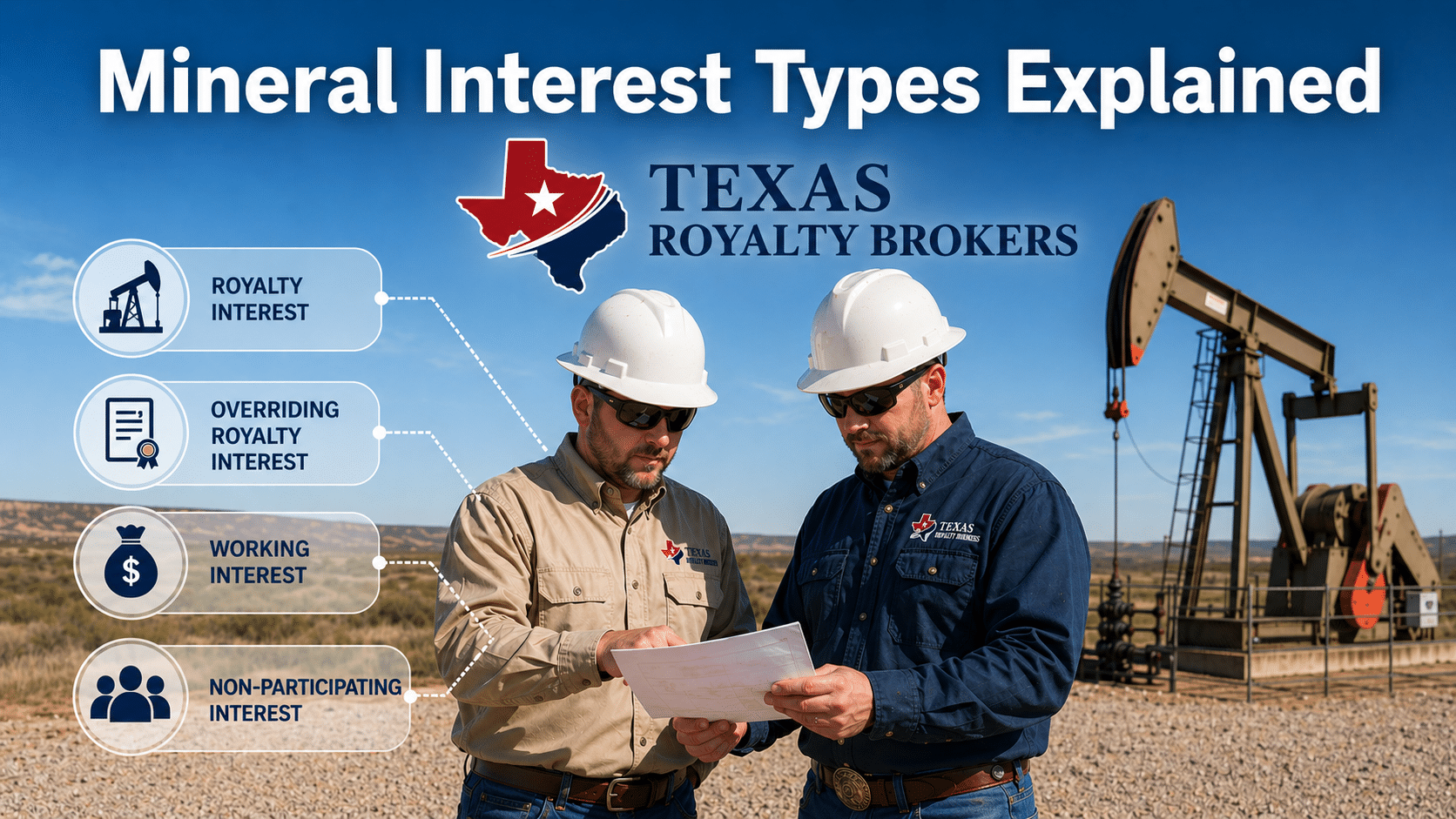
In this guide, we are going to break down the most common types of mineral interests in simple, easy to understand terms. By the end, you will have a much clearer picture of how each type works and why it matters for your bottom line.
We’ll cover the following topics:
- Royalty Interest: The Most Common Type of Ownership
- Overriding Royalty Interest (ORRI): Income That Exists only With Lease
- Non-Participating Royalty Interest (NPRI): Royalty Without Control
- Executive Rights: The Power to Make Leasing Decisions
- Working Interest: The Type Most Owners Should Not Hold
- Why Knowing Your Mineral Interest Type Matters
After reading this article, you will have a clear understanding of the different types of oil and gas interests and what they mean.
Royalty Interest: The Most Common Type of Mineral Ownership
A royalty interest is the type of ownership most people are referring to when they say they own mineral rights. In many cases, this represents what you could think of as full ownership of the mineral rights.
If this is what you have, you are in a strong position as a mineral rights owner. You typically have the right to negotiate and sign oil and gas leases, collect lease bonuses, and receive royalty income from production.
With a royalty interest, you receive a percentage of the revenue from oil and gas production. This percentage is defined in an oil and gas lease, often something like 12.5%, 18.75%, 20% or 25% depending on when the lease was signed and the level of competition at the time.
One of the biggest advantages of a royalty interest is that you are not responsible for the costs of drilling or operating the well. The oil company covers those expenses, and you receive your share of the production revenue without having to pay out of pocket.
This is what makes royalty ownership so attractive. You get the upside of production while avoiding the financial risk that comes with drilling and operating wells.
A royalty interest is often the most valuable type of mineral ownership when it comes time to sell mineral rights in Texas. Buyers are willing to pay a premium for that steady, cost free income stream.
If you see “RI” or simply “R” on your check stub under “Interest Type” this typically means you have a royalty interest.
Overriding Royalty Interest (ORRI): Income That Exists Only With the Lease
An overriding royalty interest, or ORRI, is a type of income interest that often comes from the leasing process itself.
In many cases, this goes back to how a lease was originally put together. For example, someone such as a landman or early investor may have leased mineral rights from an owner at a lower royalty rate, something like 12.5% or 18.75%. They then assign or sell that lease to an operator at a higher royalty rate, such as 20% or 25%.
Example: A family member in the past leased the mineral rights from someone for 12.5%. They later sold this lease to an operator, but at a 25% lease rate. The operator would be 12.5% to the mineral owner, and 12.5% to your family member as an ORRI. You would have inherited a mineral interest that was not actually mineral rights, it was a right to 12.5% of the royalty income as long as that lease produces.
From the outside, an ORRI can look a lot like a regular royalty. You receive a percentage of production revenue, and you are not responsible for drilling or operating costs. That part feels very similar.
The key difference is ownership.
With an ORRI, you do not own the underlying mineral rights. You only own the right to receive income that has been carved out of a specific oil and gas lease.
That leads to one of the most important things mineral owners need to understand. An ORRI only exists as long as the lease is in effect. If that lease expires and is not renewed, the ORRI goes away with it.
Important: What this means is that your ORRI will expire when the lease expires, meaning you may own something today but it might be nothing in the future.
This catches a lot of people off guard. On paper, it may look like you own a long term income producing asset, but in reality, your interest is tied directly to the life of that lease.
That does not mean ORRIs are not valuable. They can generate strong income while a lease is active, especially if the property is producing. But they are fundamentally different from owning mineral rights, and that difference matters when it comes to long term value and when evaluating offers to sell.
On your check stubs, the “Ownership Type” will typically list this type of ownership as “O” or “OR” or “ORR”
Non-Participating Royalty Interest (NPRI): Royalty Without Control
A non-participating royalty interest, or NPRI, is another type of royalty ownership, but it comes with an important limitation that sets it apart from full mineral ownership.
With an NPRI, you still receive a share of the revenue from oil and gas production. Just like a royalty interest or an ORRI, you are not responsible for drilling or operating costs. You get paid when there is production, without having to invest in the well.
Where things differ is in control.
If you own an NPRI, you do not have the right to negotiate or sign oil and gas leases. You also do not receive lease bonuses. Those rights belong to whoever holds the executive rights on the property.
In simple terms, you benefit from production, but you do not have a say in how the minerals are developed or when a lease is signed.
This is different from an ORRI in a very important way. An NPRI is tied to the mineral ownership itself, not to a specific lease. That means your interest does not automatically expire when a lease ends. It continues with the property and will apply to future leases as well.
That makes an NPRI a more durable, long term interest compared to an ORRI, even though it comes without control.
NPRIs are very common, especially in situations where mineral rights have been split up over time. One party may retain the executive rights and leasing authority, while others hold NPRIs and receive a portion of the royalty.
Even without control, an NPRI can still carry significant value, particularly in areas with strong development activity. But understanding that you do not control leasing is key when evaluating both your income potential and any offers to sell.
NPRI Conflict of Interest
There is a natural conflict of interest between someone who has an NPRI and the person who owns the executive rights (rights to lease). The person leasing the mineral rights has an incentive to collect the largest lease bonus possible. In many cases, they do not receive the royalty income, only the leased bonus so their goal is to maximize the lease bonus.
What this means is that the executive rights owners is likely to lease at the lowest rate possible (12.5%) to get the highest lease bonus possible. The lower the royalty rate, the higher the lease bonus. As an NPRI owner, this means the executive rights owner is likely to negotiate a lease that goes against your best interests.
On your check stub, the “Ownership Type” will often list “NP” or “NPRI”
Executive Rights: The Power to Make Leasing Decisions
Executive rights are all about control.
If you own executive rights, you have the authority to make decisions about leasing the minerals. This includes negotiating the terms of an oil and gas lease, choosing which company to lease to, and signing the lease itself.
In many cases, mineral owners hold both the royalty interest and the executive rights together. That is what we talked about earlier as full ownership. Over time, these rights can be separated and sold or passed down to different people.
When that happens, one person may control the leasing decisions, while others, like NPRI owners, simply receive a share of the royalty.
This is an important distinction because the person with executive rights has a lot of influence over the value of the minerals. They can negotiate for higher royalty rates, better lease terms, and work with operators who are more likely to develop the property or choose a path that provides them with the highest lease bonus possible but unfavorable terms for the NPRI owner.
If you do not own executive rights, it does not mean your interest has no value. It just means you are relying on someone else to make the key decisions that affect your income.
Understanding whether or not you hold executive rights is a big piece of understanding your overall mineral position, especially if you are considering selling.
Working Interest: The Type Most Owners Should Not Hold
A working interest is very different from the other types of mineral ownership we have covered, and for most mineral owners, it is not something you want to keep.
With a working interest, you are responsible for your share of the costs to drill, complete, and operate a well. That means you are paying for your portion of everything, whether the well performs well or not.
In return, you receive a share of the revenue from production. However, that revenue only comes after expenses are accounted for, and in many cases, those expenses can be significant.
This is where things get tricky.
A working interest is not always an asset. In some situations, it can actually become a liability. If a well has high operating costs or under performs, you can end up with little to no income, or even ongoing expenses.
That is why working interests are typically held by oil and gas companies or experienced industry professionals who understand the risks and have the ability to manage them.
For most individual mineral owners, holding a working interest does not make sense unless you have deep, hands on knowledge of the oil and gas industry.
There is also a major issue when it comes to selling mineral rights.
Working interests are often difficult to sell, and in some cases, nearly impossible. If your interest is not generating strong positive cash flow, most buyers simply are not interested. If your monthly cash flow is neutral or negative, you may not be able to sell it at all.
Even if your working interest is producing some income, buyers are very selective. In general, you need to be generating meaningful positive cash flow before it becomes marketable.
Many owners who receive a working interest, often through inheritance or a deal they did not fully understand, look to sell as soon as possible.
If you find yourself in that position, the most important thing is to understand exactly what you have and what it is producing. From there, you can determine whether there is an opportunity to exit and convert it into something more stable.
For most mineral owners, the goal is simple. Move out of the risk and into a position where you can benefit from production without being responsible for the costs.
Note: If you own a working interest, we highly recommend selling as soon as possible. These often turn into a liability and truly should not be held by the vast majority of people who own them.
Why Knowing Your Mineral Interest Type Matters
At this point, you can probably see that not all mineral interests are created equal.
Some come with full ownership and long term value. Others are tied to a lease that can expire. Some give you control over decisions, while others leave you relying on someone else. And in certain cases, like a working interest, you may even be taking on financial risk without realizing it.
This is why understanding exactly what you own is so important.
Your mineral interest type has a direct impact on how much your property is worth. Buyers look at each type very differently. A royalty interest with strong production will typically bring higher offers than an ORRI tied to a single lease. An NPRI may still be valuable, but it lacks control. A working interest may be difficult to sell at all depending on its performance.
If you are not clear on what you own, it becomes very difficult to know whether an offer is fair. This is where a lot of mineral owners leave money on the table. They may accept the first offer that comes in without realizing their interest could be worth more, or in some cases, less than they think.
It also affects timing.
For example, if you have an ORRI tied to a lease that may expire, timing becomes critical. If you have a working interest that is generating income, there may be a window where it is actually marketable. If you wait too long in either situation, your options can change quickly.
This is exactly why having the right guidance matters.
At Texas Royalty Brokers, we help mineral owners identify exactly what they own, understand how it is valued, and position it in front of serious buyers. Instead of guessing or going back and forth with a single buyer, we create a competitive process that helps drive up the price.
The goal is simple. Make sure you are fully informed and put in the best position to get the most value out of your mineral rights with the least amount of stress.