
Why Texas Royalty Brokers?



sellers
Buyers

State Specific Guides
Resources

Selling Mineral Rights in Texas: 2026 Guide

Selling mineral rights in Texas can be one of the largest financial decisions a mineral owner will ever make. The biggest risk is not usually the paperwork or closing process. It is accepting an offer before you know what the broader market is actually willing to pay.
Many mineral owners already have one, two, or even several offers in hand before they begin seriously considering a sale. Those offers can be useful reference points, but a small number of offers does not necessarily establish market value. Different buyers value the same mineral rights differently, and meaningful price discovery usually comes from exposing the property to a broader group of qualified buyers and creating competition.
At Texas Royalty Brokers, our focus is helping Texas mineral owners understand what they own, evaluate what is happening around their acreage, and determine what the market will actually pay through a competitive bidding process.
If you are considering selling, or already have offers in hand, this guide walks through the key steps to selling mineral rights in Texas:
- Understanding What You Own
- Understanding Local Activity
- Mineral Rights Value in Texas: What Will the Market Actually Pay?
- Choosing a mineral rights broker
- Preparing to sell mineral rights – documentation
- Tax implications when selling mineral rights in Texas
- Step by step summary to sell mineral rights in Texas
By the end, you should have a clear understanding of the selling process, the information buyers use to evaluate your property, and the steps you can take to avoid leaving money on the table.
Understanding What You Own
Many mineral owners in Texas inherited their mineral rights, sometimes through several generations of family ownership. You may own a valuable asset without knowing exactly how many acres you own, what type of interest you hold, or how future development could affect its value. That is very common.
Before selling, it is important to understand exactly what you own. Buyers evaluate mineral rights using details that can materially change what they are willing to pay.
A few important questions include:
- How many net mineral acres do you own?
- What is your royalty rate, and how does that translate into net royalty acres?
- Are your minerals producing, leased but not producing, or currently unleased?
- Do you own a royalty interest, overriding royalty interest, non-participating royalty interest, working interest, or another type of interest?
- Is there additional development potential remaining on the acreage?
You do not need to know the answers to all of these questions before contacting us. In fact, many mineral owners do not.
What matters is getting clarity before you make a selling decision.
At Texas Royalty Brokers, we help determine what you own, review the information available on your property, and explain the factors buyers will consider when valuing it. That gives you a much better foundation for evaluating offers and deciding whether selling makes sense.
Understanding Local Activity
Once you understand what you own, the next step is understanding what is happening on and around your acreage. Local oil and gas activity can have a major impact on what buyers are willing to pay.
Important questions include:
- Are drilling rigs operating nearby?
- Have new permits been filed?
- Are there producing wells close to your acreage?
- Are there already DUC wells on your acreage?
- Which operators are active in the area?
Serious mineral buyers study this information closely when they evaluate a property. A new permit, nearby rig, or active development program can materially change how a buyer underwrites your mineral rights.
The challenge is that most mineral owners do not regularly work with this data. You may know there is drilling nearby without knowing exactly where it is, which operator is involved, or how it relates to your ownership.
At Texas Royalty Brokers, we help close that information gap.
We can provide a custom activity map and analysis of your mineral rights at no charge, even if you ultimately decide not to sell or list with us. Depending on the area, the map may include active rigs, drilling permits, horizontal and vertical wells, nearby production, and other activity relevant to your property.
The goal is simple: help you see the same local activity buyers are evaluating before you make a selling decision.
Understanding local activity does not tell you exactly what your mineral rights are worth. However, it gives you important context about development potential, buyer interest, and why offers for the same property may differ significantly.
If you are considering a sale, we can review your ownership and walk you through what is happening around your acreage as part of a free consultation.
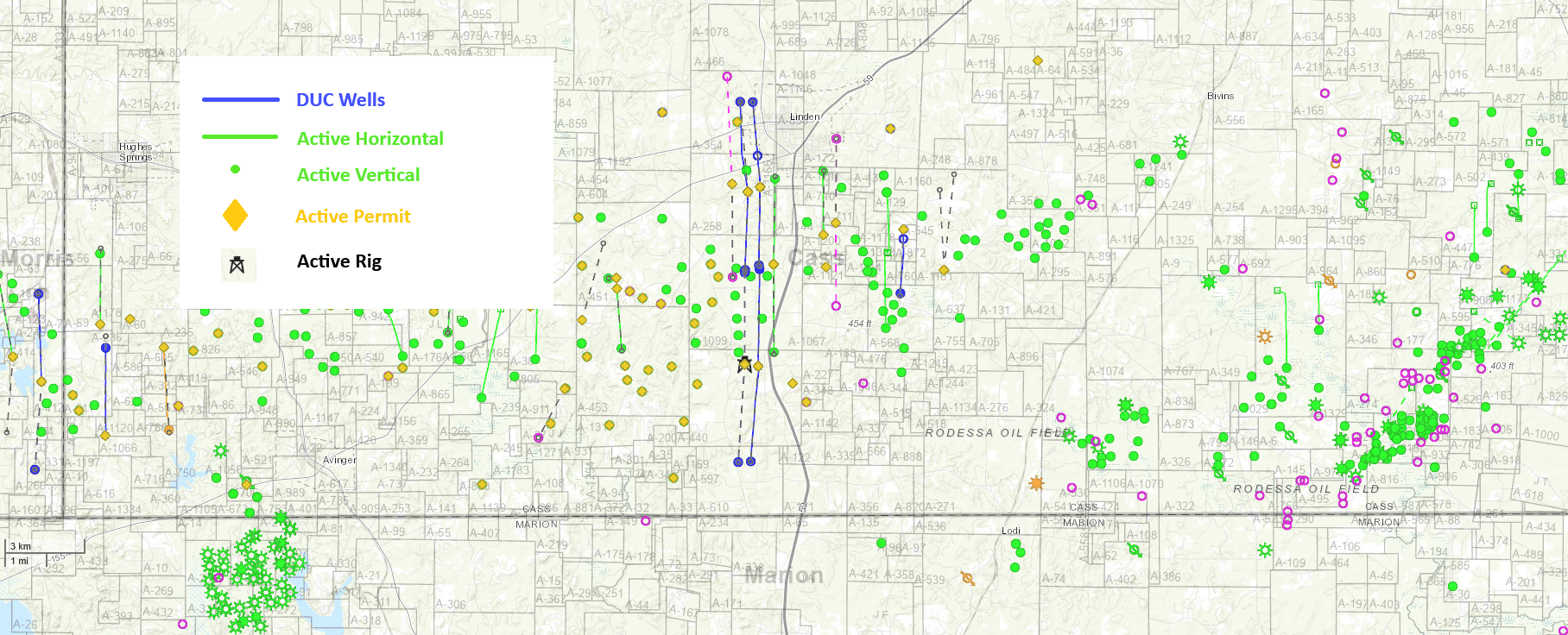
We can provide you with a map like this for your acreage. Contact us for a Free Consultation.
Mineral Rights Value in Texas: What Will the Market Actually Pay?
When you are considering selling mineral rights, one of the most important questions is simple:
What will the market actually pay?
You may already have one, two, or several offers in hand. Those offers are useful information, but they do not necessarily establish market value. Mineral buyers evaluate the same property differently based on their development assumptions, acquisition strategy, existing ownership in the area, cost of capital, and appetite for future upside.
That means two or three offers can look competitive while still representing only a small portion of the qualified buyer market.
The strongest way to determine market value is through price discovery. That means exposing the property to a broad group of qualified buyers and giving them an opportunity to compete.
At Texas Royalty Brokers, that is the core of what we do.
Real Client Results
The examples below are REAL Texas Royalty Brokers client transactions. These are not projections or hypothetical outcomes. They show actual offers our clients had in hand compared with what they ultimately received after going through the competitive sale process with Texas Royalty Brokers.
REAL CLIENT RESULT
$3.4 Million Offer → $4,178,750 Net to Client
This client came to Texas Royalty Brokers with an existing offer of approximately $3.4 million. It was a complicated multi-county transaction involving substantial title issues, curative work, and a difficult post-closing true-up.
After going through the competitive sale process with Texas Royalty Brokers, the client ultimately received $4,178,750 after our commission.
REAL CLIENT RESULT
$2.52 Million Offer → $3,127,125 Net to Client
This client was a firefighter preparing for retirement, and the sale represented a substantial portion of his retirement plan. He was understandably nervous and came very close to accepting an existing $2.52 million dollar offer.
After exposing the property to competitive buyers through Texas Royalty Brokers, he ultimately received $3,127,125 after our commission.
REAL CLIENT RESULT
$117,112 Offer → $308,240 Net to Each Sister
2.6X THE ORIGINAL OFFER
Two sisters came to Texas Royalty Brokers after receiving an offer of $117,112.50 each for their mineral rights. Rather than accepting the offer, they allowed Texas Royalty Brokers to take the property through a competitive process.
Each sister ultimately received $308,240.10 after our commission.
That is more than 2.6 times the original offer, even after commission.
These real transactions show why an existing offer, a few similar offers, or a simple valuation shortcut can create false confidence about what mineral rights are actually worth.
That is why we do not believe a calculator, royalty multiple, average price per acre, rule of thumb, AI estimate, or a small number of existing offers can reliably establish market value.
The examples above are real reminders that a reasonable-looking offer can still leave substantial money on the table.
The goal is not to predict how much more your mineral rights might sell for. The goal is to find out before you sign them away.
Texas Royalty Brokers gives qualified buyers the opportunity to compete so you can evaluate real market bids before you sell them below market value.
Choosing a Mineral Rights Broker in Texas
Not all mineral rights brokers approach a sale the same way. A good broker should do more than simply collect an offer and pass it along. Their job is to understand your property, reach the right buyers, create competition, and help you successfully get through closing.
Here are some of the most important things to look for:
✅ Texas Mineral Market Experience
Texas mineral values can vary dramatically from one county to the next. Drilling activity, operators, geology, production, and future development all affect buyer interest. A broker who specializes in Texas mineral rights should understand these differences and know how to present your property to buyers who are actively investing in your area.
✅ Access to Qualified Buyers
Buyer relationships matter. A strong broker should have access to a large group of qualified mineral buyers, including buyers you may never encounter through mailed offers or your own outreach. The goal is not simply to find a buyer. It is to identify the buyers most likely to value your specific property and give them an opportunity to compete.
✅ A Competitive and Transparent Process
Ask how the broker actually markets your mineral rights and handles offers. At Texas Royalty Brokers, properties are marketed directly to qualified buyers and presented through our public listing platform. Buyers are given a clear bidding timeline, which helps create competition and gives sellers real market bids to compare.
✅ Closing and Escrow Process
Peace of mind is critical. A strong broker will have a defined closing process that protects you and ensures that funds are secured before you transfer ownership. This eliminates risk and ensures you get paid in full.
✅ Experience Getting Deals Closed
The highest offer is not very useful if the buyer cannot close. Mineral transactions can involve title issues, ownership questions, curative requirements, purchase agreements, and post-closing adjustments. An experienced broker should help you navigate these issues and keep the transaction moving from initial bids through closing.
✅ A Proven Track Record
Look for evidence, not just promises. A broker should be able to demonstrate experience handling real mineral transactions and successfully representing mineral owners through the entire selling process.
At Texas Royalty Brokers, mineral rights sales in Texas are our primary focus. We understand the Texas market, work with a large network of active buyers, run a competitive bidding process, and guide our clients from the initial property review through closing.
If you decide to sell, the broker you choose can have a meaningful impact on both the price you receive and how smoothly the transaction closes.

Preparing to Sell Mineral Rights: Documentation
You do not need perfect records to begin the selling process, but good documentation helps buyers understand exactly what they are evaluating and can make the bidding and closing process much smoother.
At Texas Royalty Brokers, we help organize the information buyers need and identify anything that may be missing.
If Your Mineral Rights Are Producing Royalty Income
The most useful documents are usually your three most recent royalty statements.
Many operators provide royalty statements through services such as EnergyLink, so copies can often be downloaded online.
If Your Mineral Rights Are Leased but Not Producing
Two documents are especially helpful:
Oil and Gas Lease – Your lease shows important terms such as the royalty rate, lease term, legal description, and other provisions that may affect value.
Order for Payment – If available, this can help confirm the amount of acreage leased, bonus amount, and other details related to the transaction.
Helpful Documents for Any Mineral Owner
The following are useful, but they are not required before contacting us:
- Division orders, which can help confirm your ownership and decimal interest
- Mineral deeds or conveyance documents, which show how you acquired the mineral rights and identify the property
- Probate or inheritance records
- Older deeds, ownership records, or family documents
- Any other information you have relating to the property
Do not worry if your records are incomplete.
Send us what you have. Texas Royalty Brokers can help determine what additional information is needed and work through ownership or documentation questions with you.
Good documentation gives buyers more confidence in what they are bidding on and helps reduce surprises once a property goes under contract.
Tax Implications When Selling Mineral Rights in Texas
Don’t skip this section!!! Taxes are boring, but we will quickly show you how to save a fortune in taxes.
When you sell mineral rights in Texas, the sales price is only part of the story. What really matters is how much you keep after taxes.
The good news is that Texas has no state income tax, so you only have to consider federal taxes.
For most mineral owners, the sale of mineral rights is taxed as a long-term capital gain. The rate you pay depends on your income, but for many people the rate is 15%. It could be more or less depending on your tax bracket, but 15% is the most common.
Example: $1,000,000 sale vs. $1,000,000 in royalties
If you sell your mineral rights for $1,000,000, a 15% capital gains tax means you pay $150,000 in taxes. You walk away with $850,000 in your pocket.
Now compare that to receiving $1,000,000 in royalty income over time. Royalties are taxed as ordinary income, not capital gains. That means you could pay 24% to 37% in federal taxes. At 32%, you would owe $320,000 in taxes, leaving only $680,000.
If you sold the mineral rights, you would have saved $170,000 in taxes compared to collecting royalty income. Selling mineral rights can often save you a fortune in taxes compared to holding and collecting royalty income.
Inherited mineral rights and step-up basis
If you inherited mineral rights, the tax advantages can be even greater. When mineral rights are inherited, the cost basis resets to the market value at the time of inheritance. This step-up in basis can dramatically reduce your taxable gain.
For example, imagine you inherited mineral rights valued at $900,000 in 2018 and sold them this year for $1,000,000. Your taxable gain would only be $100,000. At 15%, your tax bill would be just $15,000. That means you keep $985,000 out of the $1,000,000 sale! Seriously, this is possible.
Compared to collecting $1,000,000 in royalty income and paying $320,000 in taxes, selling could leave you with more than $300,000 extra in your pocket.
Curious how this would apply to you? If you haven’t sold yet, contact us and we’ll provide a free consultation and show you the tax savings.
Why this matters
Taxes should never be the only factor in your decision, but they are a major piece of the puzzle. The way the tax code is structured often makes selling far more favorable than holding for long-term royalty income, especially with inherited properties.
At Texas Royalty Brokers, we are not tax advisors, but we help mineral owners every day who are weighing these decisions. We can explain the basics and work alongside your CPA to make sure you understand the potential savings.
Our mineral rights tax article has more in depth information which you may find helpful.
Step-by-Step Summary to Sell Mineral Rights in Texas
We’ve covered a lot of ground in this guide. To wrap it up, here is a simple step-by-step summary of how to sell mineral rights in Texas the right way. Our goal is to help you maximize value while making the process as smooth as possible.
-
Understand what you own
Know how many net mineral acres or net royalty acres you hold, and whether there is upside potential left on your acreage. -
Understand local activity
Look at rigs, permits, and active wells around your property. This shows how much demand and future value your minerals may have. -
Estimate value
Remember that there is no average price per acre. Value comes from cash flow plus upside, and the only way to know the true value is through competition. -
Gather documentation
Royalty statements, division orders, leases, deeds, and ownership history all help buyers sharpen their pencils and make stronger offers. -
Choose the right broker
A strong broker brings local knowledge, buyer competition, a visible listing platform, and expertise to guide you through the process. -
Create competition among buyers
Listing your minerals with Texas Royalty Brokers exposes your property to a wide range of serious buyers, which pushes offers higher. -
Navigate taxes and closing
Understand the tax benefits of selling, especially if you inherited your minerals. Then close securely through escrow with expert guidance every step of the way.
Selling mineral rights in Texas does not have to be confusing or overwhelming. With the right process, you can feel confident that you know exactly what you own, what drives value, and how to get the best price.
At Texas Royalty Brokers, we specialize in making that happen. From free consultations and activity maps, to competitive bidding and secure closings, we are here to help you sell with confidence and walk away with the highest possible value.
Contact Texas Royalty Brokers
Before you accept an offer, find out what the true market value is by getting competitive bids.
Whether you already have offers in hand or are just beginning to consider selling, Texas Royalty Brokers can review your ownership, local activity, and existing offers as part of a free consultation with no pressure or obligation.
You do not need to have everything figured out before contacting us. Send us what you have, and we will help you understand the property, your options, and the next steps.
Whether your mineral rights are worth $10,000 or $10 million, our goal is the same: give you the information and market exposure you need to make a confident decision.
Use the form below to get started: