
Why Texas Royalty Brokers?

sellers
Buyers

State Specific Guides
Resources
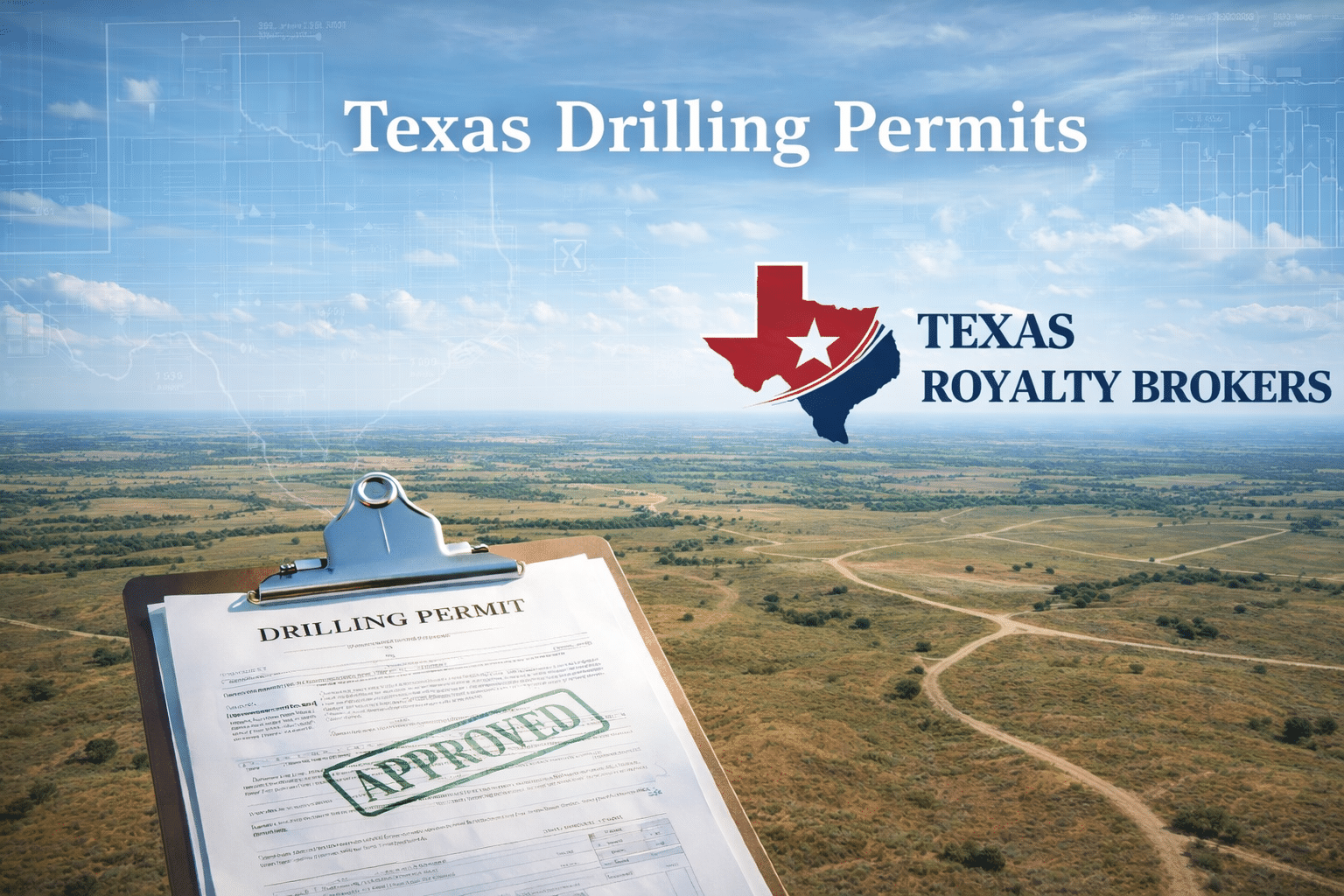
Texas Drilling Permits – Current Activity Across Texas

Understanding Texas drilling permits is one of the most important first steps in evaluating potential oil and gas activity near your property. A drilling permit signals that an operator is preparing for a possible well, but it does not guarantee that drilling will occur or when it might happen.
This page provides a clear, up-to-date view of currently active Texas drilling permits, broken down by county and visualized across the state using a heat map. Whether you are a mineral owner, landowner, mineral rights investor, or simply tracking drilling activity, these tools help you see where permitting activity is concentrated and how it compares across Texas.
Use the tools below to:
✅ Search active drilling permits by county – (permit tool)
✅ Identify counties with the highest permitting activity (permit tool)
✅ Visualize permitting trends across the entire state (heat map)
Both of these tools will provide you with valuable information about Texas oil and gas permitting activity.
Texas Drilling Permits Tool
Active Texas Drilling Permits by County
The Texas drilling permits tool below shows the number of currently active oil and gas drilling permits filed in each Texas county. This view allows you to quickly identify where operators are preparing for potential drilling activity and which counties are seeing the most permitting momentum.
You can:
✅ Start typing a county name to view permits for a specific area
✅ See the total number of active permits statewide
✅ Identify the counties with the highest concentration of permits
✅ Expand a county to view individual abstracts tied to permitted locations
If a county does not appear in the results, it currently has zero active drilling permits in the dataset.

| County | Active Permits | Abstracts |
|---|
✔ Tip: Texas drilling permits are often the first public signal that an operator is considering future development in an area. A permit shows intent and planning, but it does not guarantee that a well will be drilled or when activity might occur. Many permits are filed months or even years before any drilling takes place, and some permitted locations are never drilled at all.
This tool is designed to help you see where active Texas drilling permits exist today and how that activity is distributed across counties.
Active Texas Permits Heat Map
The Texas drilling permits heat map provides a statewide view of current permitting activity. Instead of focusing on a single county, this map shows how permits are distributed across Texas and where operator interest appears most concentrated.
Counties with higher numbers of active permits are shaded more intensely, while counties with little or no permitting activity appear lighter. This makes it easier to identify regional patterns and understand how one area compares to others across the state.
The heat map is especially useful for gaining context. A county with a handful of permits may feel active in isolation, but when viewed alongside surrounding counties, broader development trends become clearer.
While drilling permits can indicate potential future activity, they are only one piece of the larger picture. Permits do not determine whether a well will be drilled, how productive it might be, or what mineral rights could ultimately be worth.
Understanding what oil and gas permits mean, and what they do not, is very important.
What Does a Texas Drilling Permit Mean?
A Texas drilling permit is an application filed with the Texas Railroad Commission requesting approval to drill a well at a specific location. It is a regulatory step that allows an operator to proceed if they choose to do so.
A permit does not mean a rig is scheduled. It does not mean production is guaranteed. It simply means the operator has secured permission to drill under current rules and spacing requirements.
Permits, Leases, and Drilling: What’s the Difference?
It’s very common for mineral owners to see a drilling permit and assume drilling is about to happen. In reality, permits, leases, and drilling are three separate steps, and they don’t always move in order or on a predictable timeline.
A mineral lease gives an operator the legal right to drill and produce oil or gas from the minerals. Without an oil and gas lease in place, an operator generally cannot drill, even if a permit exists. Leasing activity often happens well before any permit is filed, but in some cases leasing may still be ongoing or incomplete when a permit appears.
A drilling permit is a regulatory approval issued by the Texas Railroad Commission. It allows an operator to drill a well at a specific location under approved spacing and safety rules. A permit does not require the operator to drill. It simply gives them the option to proceed if and when they choose.
Drilling only occurs when an operator commits capital, schedules a rig, completes title and regulatory work, and decides that market conditions support moving forward. Many permitted locations never reach this stage, especially during periods of price volatility or shifting development priorities. To see active rigs in Texas, check out our Texas Rig Count map.
Because of this, a drilling permit should be viewed as a signal of planning and interest, not a guarantee of activity. Permits can remain active for long periods, be amended, expire, or be withdrawn entirely without a well ever being drilled.
After drilling, a well does not always move straight into production. Many wells are drilled and then left uncompleted, commonly referred to as DUC wells, or Drilled but Uncompleted wells. In these cases, the wellbore has been drilled, but hydraulic fracturing and final completion have not yet occurred. Operators may delay completion due to commodity prices, infrastructure timing, or broader development plans, meaning production and royalties can still be months or years away.
Understanding the difference between these steps helps set realistic expectations and prevents overestimating how soon drilling, or oil and gas royalty income, might occur.
How Long After a Permit Is Filed Does Drilling Occur?
One of the most common questions mineral owners ask is how long it takes for drilling to begin after a permit is filed. The short answer is that there is no standard timeline.
In Texas, drilling permits are generally valid for one year from the date they are approved by the Texas Railroad Commission. However, permits are often extended or amended to extend beyond one year.
During that time, an operator has the option to drill, but they are not required to do so.
Some wells are drilled within weeks or months of permit approval. Others may take years, especially if permits are renewed or refiled. In many cases, a permitted location is never drilled at all.
Drilling timelines depend on factors such as commodity prices, operator budgets, lease status, infrastructure availability, and shifting development priorities. Because of this, a drilling permit should be viewed as an early signal of interest, not a reliable indicator of when drilling or production will actually occur.
How Mineral Owners Should Use Texas Drilling Permit Data
Texas drilling permit data is most useful when it is treated as context, not a conclusion. Permits can indicate where operators are focusing attention, but they do not determine whether drilling will occur or when revenue might follow.
For mineral owners, permit data can help answer directional questions. Is activity increasing in a county or slowing down? Are operators consistently filing permits in one area while avoiding others? Is permitting concentrated around existing production, or expanding outward?
Permit data should always be considered alongside other information, such as leasing activity, rig counts, historical production, and the specific location of your minerals within a unit. Looking at permits alone can lead to unrealistic expectations, especially when timelines stretch out or plans change.
When used correctly, drilling permits provide an early signal of interest. They help frame the bigger picture, but they are only one part of understanding how and when minerals may be developed.
Texas Drilling Permit Data Sourcing
All drilling permit data shown on this page is sourced from the Texas Railroad Commission (RRC), the state agency responsible for regulating oil and gas activity in Texas. The RRC publishes public records related to drilling permits, well filings, and regulatory approvals across the state.
Texas Royalty Brokers organizes and visualizes this public data to make it easier to search by county and understand statewide permitting trends. The original source data is available directly from the Texas Railroad Commission at https://www.rrc.texas.gov.